
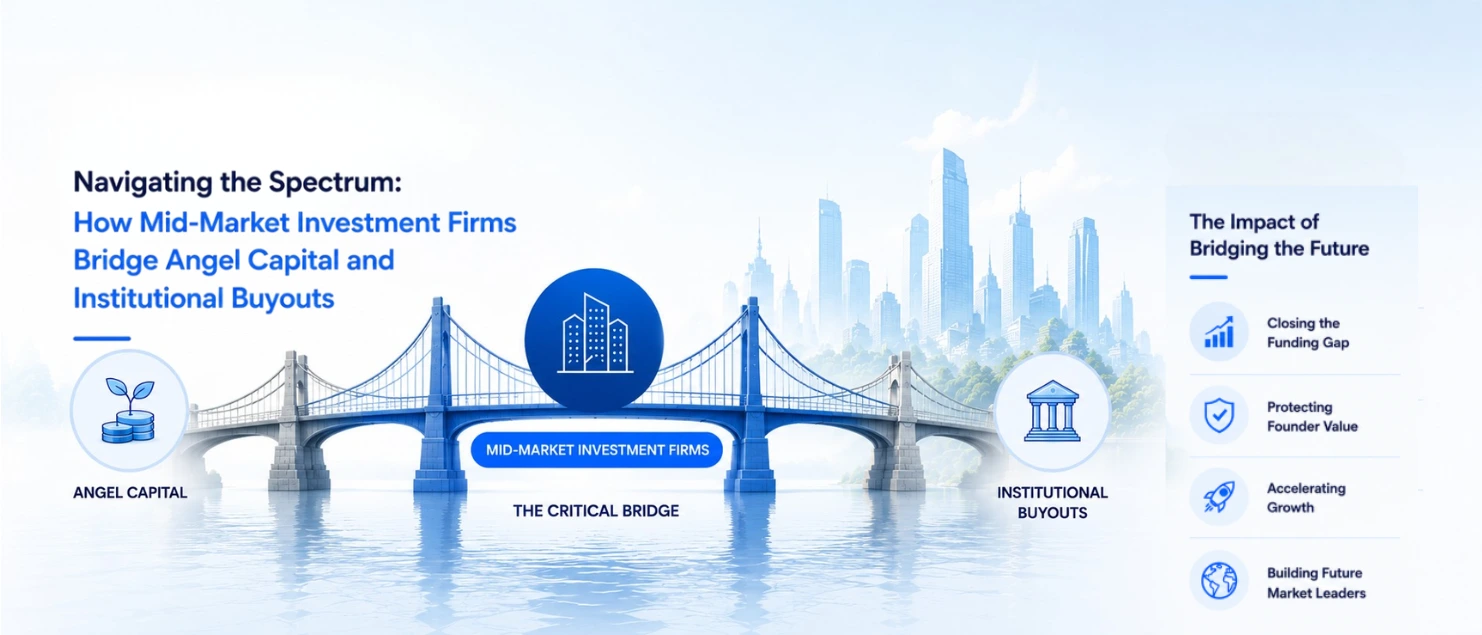
Navigating the Spectrum How Mid-Market Investment Firms Bridge Angel Capital and Institutional Buyouts in Venture Capital Investment in Europe
Over the last decade, the setup of European startup network has developed at an astonishing pace. Traditionally, companies followed a standard and fragmented path to scale a high-growth in the businesses. Founders generally secured initial capital from angel investors, scaled up through early-stage venture capital, and eventually intent for big institutional buyouts or public listing.
The catch is that modern breakthroughs, like deep tech, AI, and the Industrial Internet of Things (IIoT) innovations require comparatively longer incubation period and more intensive commercialization, as a result, they often run into a structural disconnect in the funding ecosystem. While finding seed money for the startups is relatively accessible and late stage private equity remain greatly capitalized. However, the critical transition period, the mid-market space is the phase where a startup business must transform from authorized technology into something scalable communal entity is frequently afflicted by funding gaps.
To understand the true health of venture capital investment in Europe, you can’t just look at seed rounds, you have to look at whether companies can actually survive the transition to institutional scale.
The Funding Gap in Europe’s Startup Journey
Traditionally, the European Funding setups has two clear bookends, initially angel investors deliver the agility and sufficient fund required to turn the rough idea into a functional minimum viable product (MVP). On the other end spectrum sit establishes private equity firms and buyout funds, which do not look for early-stage chaos, rather than look for recognized market leaders with highly predictable cash flow and well-recognized market dominance.
The real bottleneck happens right in the middle. Startups specializing in capital-reliant, deeply technical verticals like robotics, Artificial Intelligence, IoT, and sustainable technologies, frequently run out of early-stage runway just as they are ready to actually hit the market.
This transition is where scaling companies usually hit a wall. The typical venture capital minimum investment in Europe for top-tier institutional funds is often just too high for an emerging scale-up to absorb without completely gutting their founders’ equity. Because these big funds insist on writing massive checks, mid-market startups get caught in no-man’s-land. They outgrow angel syndicates, but they don’t yet have the local market scale to justify giant private equity rounds. Specialized mid-market firms are stepping in to bridge the gap.
Strategic Positioning: Is Boundary Holding a Venture Capital, Private Equity, or an Angel Investment Firm?
When evaluating the firms operating in this mid-market space, traditional business labels often fall apart. Now the question arises regarding specific market participants: Is Boundary Holding a venture capitalist, a private equity firm, or an angel investment network?
The truth is, Boundary Holding is built specifically to break those old definitions. Boundary Holding operates as a specialized strategic investment firm built specifically to bridge these traditional definitions. Rather than fitting into a single category, the firm categorizes distinctive deep tech and industry 5.0 companies that have just started commercialization, stepping in with tailored capital structures and executional resources.
Boundary Holding bridges the ecosystem through three core pillars:
- The Power of the Bridge Round: Companies often need interim funding to hit key growth milestones before they can trigger a massive institutional round. Boundary Holding’s track record in this bridge-funding space gives startups the runway to expand their market footprint and refine their business models. Crucially, it protects founders from taking an unnecessary hit on long-term valuation or suffering heavy, premature equity dilution.
- Active Scaling and commercialization: Rather than behaving like an angel investors or directing purely on financial returns like traditional venture capitalists, the firm acts as a hands-on strategic partner. It targets original ideas that ranges from AI and railway analytics to environmental safety and drone technologies. The firm helps founder to convert their innovative and disruptive tech into revenue generating businesses.
- Evolving into Private Equity: Indicating the true fluid nature of the mid-market landscape, Boundary Holding evolved its setup by introducing a dedicated Private Equity (PE) Fund. The initiative is specifically designed to back sustainable technologies and industry 5.0 scale-ups that require financial strength and corporate governance structure characteristic of Private equity, combined with the tech-competence of a venture fund.
Mitigating the Structural Challenges of European Venture Capital
For Europe tech sector to remain competitive worldwide, the system requires investors or investment firms that can bridge the gap between initial stage momentum and more rigid institutional framework. By stepping in with targeted bridge funding and growth equity, these mid-market players can prevent the “valley of death” or “Funding-Gap” that claims many promising deep tech ventures.
Ultimately, these strategic investors do a lot more than just write checks. They clean up the company’s equity structure, fix daily operations, and give founders the time they need to hit global regulations and sales targets. Essentially, they act as a bridge. They take a raw, exciting idea funded by early angel investors and turn it into a strong, mature business that big private equity firms actually want to buy.