
Decoding Venture Capital Minimum Investment in Europe: A Founder’s Practical Guide to Raising the Right Round
Of all the mistakes an entrepreneur can make when seeking funding, one of the most commonly made is targeting a fund that is totally mismatched for that entrepreneur in terms of the size cheque that they can write. Knowing what the minimum investment for venture capital in Europe is, and how it varies by sector, stage and geography is essential to developing a smart funding strategy.
In this guide, we present the key aspects of European venture capital minimum investment that founders have to be aware of, how major European VC firms work and why the lowest possible minimum investment is not always your best choice.
Why Minimum Investment Size Is a Structural Reality, Not a Preference
The economic architecture makes it possible for every venture fund to figure out the minimum cheque that can be written. For instance, a fund managing €500 million and getting ready for 20 investments will need to invest a minimum €25 million in each company. The calculations make it impossible for such a fund to be able to invest in a €1 million seed round. This means that even if the fund is interested in taking part, the amount will simply be too small for such an investment.
This is the reason why the term minimum cheque problem was coined as well. There is always a ceiling that limits the amount of money the fund can invest in every company. Why do founders not take this into consideration while looking for investors? This misunderstanding leads to a time wasting process of pitching funds that are not suitable for the round size.
The European Investment Threshold Landscape by Stage
There are some notable distinctions between the European and US venture markets, something founders must adjust for.
A typical seed round in Europe ranges from €1 million to €3 million, compared with the $3 million to $5 million average in the US, and that gap is crucial for founders to remember when targeting European companies.
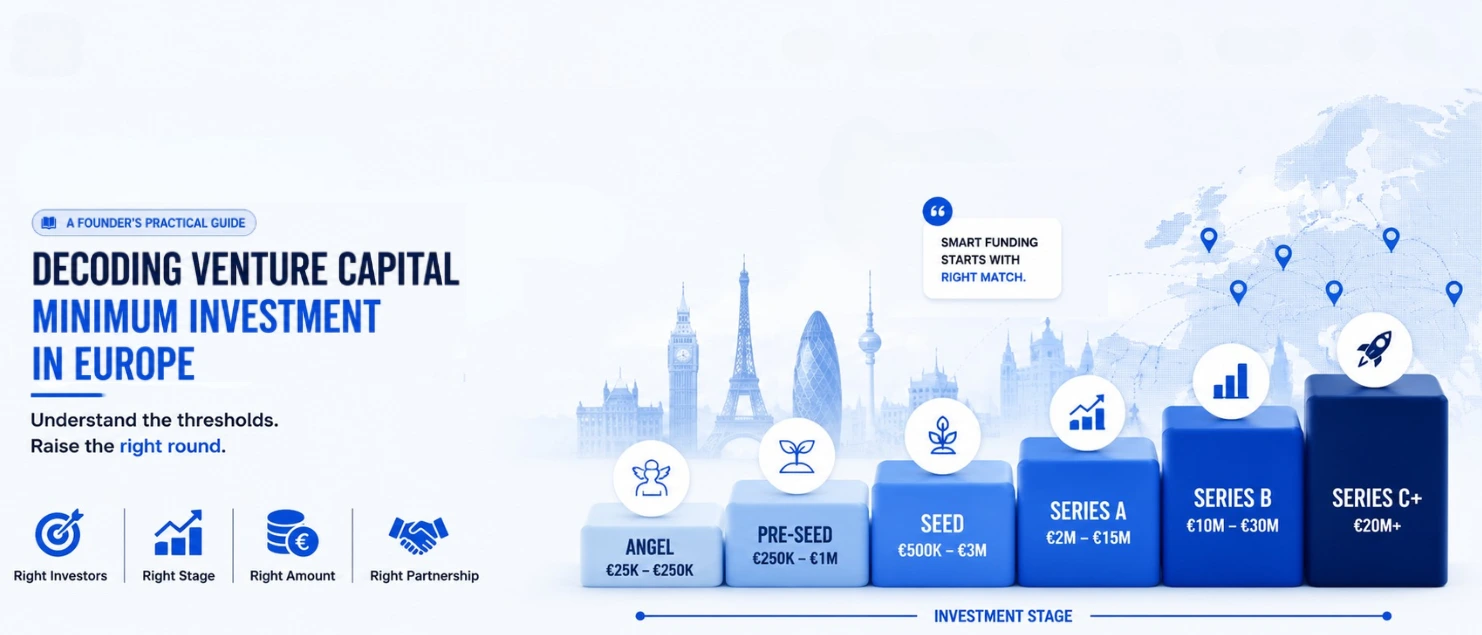
The earliest stage of investing is characterized by the angel round, where angel investors take the lead and put in anywhere from €25,000 to €250,000, then quickly follow up with accelerators that provide larger investments but include extra services.
A pre-seed fund typically pays anywhere from €250,000 to €1 million, with seed VC investors giving the lead check in the range of €500,000 to €3 million.
More sophisticated investments happen in Series A, initial check sizes are ranging from €2 million to €15 million, in Series B ranging from €10 million to €30 million, while Series C and beyond entails checks from €20 million to €100 million or more in size.
The shift in pre-seed sizing is real and worth pricing into any fundraising plan strong teams are now raising pre-seed rounds of $1 million to $3 million, up from the $500,000 to $750,000 range of just two years ago. Rounds are larger because real engineering talent costs more, and competition for senior hires at the frontier of deep tech has pushed burn rates up before a single line of revenue is generated.
What the Current European Market Is Telling Founders
Beyond the raw thresholds, the current investment environment carries important signals about what the best venture capital firms in Europe are actually demanding in exchange for their minimum cheques.
Where a promising team and an addressable market once unlocked €2 to €3 million seed rounds, investors now expect clear unit economics and a credible path to break even within 18 months. The median time between seed and Series A stretched to 22 months in 2024, up from 16 months in 2021.
Investors are focusing capital on companies demonstrating scale, clear paths to profitability, and defensible market positions. Startups operating outside these parameters continued to face a challenging fundraising environment, often accepting tougher terms or exploring alternative funding structures such as venture debt.
This bifurcation is significant. It means the minimum investment threshold a founder needs to clear is not simply about round size it is equally about the proof points required to unlock that capital in the first place. Raising a €1.5 million seed round in 2026 demands substantially more validation than raising the same amount did in 2021.
Deep Tech: Where Minimums and Timelines Diverge from the Standard Playbook
In order for founders in the field of artificial intelligence, robotics, autonomous systems, quantum computing, or advanced hardware to understand the minimum investment conditions in venture capital in Europe, they need to look at this issue in detail.
Deep tech businesses experience longer development cycles, greater capital costs that arise before revenue generation, and fundamentally different milestones than software companies. More than 90% of deep tech startups fail because of their difficulties in raising funds rather than their technological problems. The necessity to create market-ready products and meet regulatory requirements puts a huge financial burden on deep tech companies.
The minimum investment talks for a deep tech founder are not about a single check but about different sources of finance combined over a development process which can take from five to eight years. The best venture capital companies involved in deep tech in Europe understand this and structure their minimum involvement accordingly.
The start of 2026 is showing signs of recovery, but it is the specialists who are being rewarded. Fund sizes, which dipped in 2025, are bigger than ever the median in Q1 stood at €85 million, 70% higher than the previous year. Larger fund sizes mean larger minimum cheques and a further narrowing of the gap between early-stage capital availability and what deep tech companies actually need to reach commercialisation.
How Boundary Holding Thinks About Minimum Investment
Boundary Holding is among the top venture capital companies in Europe, focusing on deep tech frontier and treating minimum investment not as a required threshold, but as a strategic lever. It invests in artificial intelligence, robotics, automatic drones, and advanced sensor technologies requiring Patience along with smart financial management.
The company’s strategy of finding the companies prior to getting noticed by the public ensures that its first investment depends on the actual stage of the business rather than predetermined schemes.
According to their motto “Mentorship without Interference”, the firm believes that the optimum investment a startup can get is one that will be secured with sufficient runway.
Understanding venture capital minimum investment in Europe is of primary importance for deep tech entrepreneurs because aligning with a company whose requirements match their state of development is the key to success.