
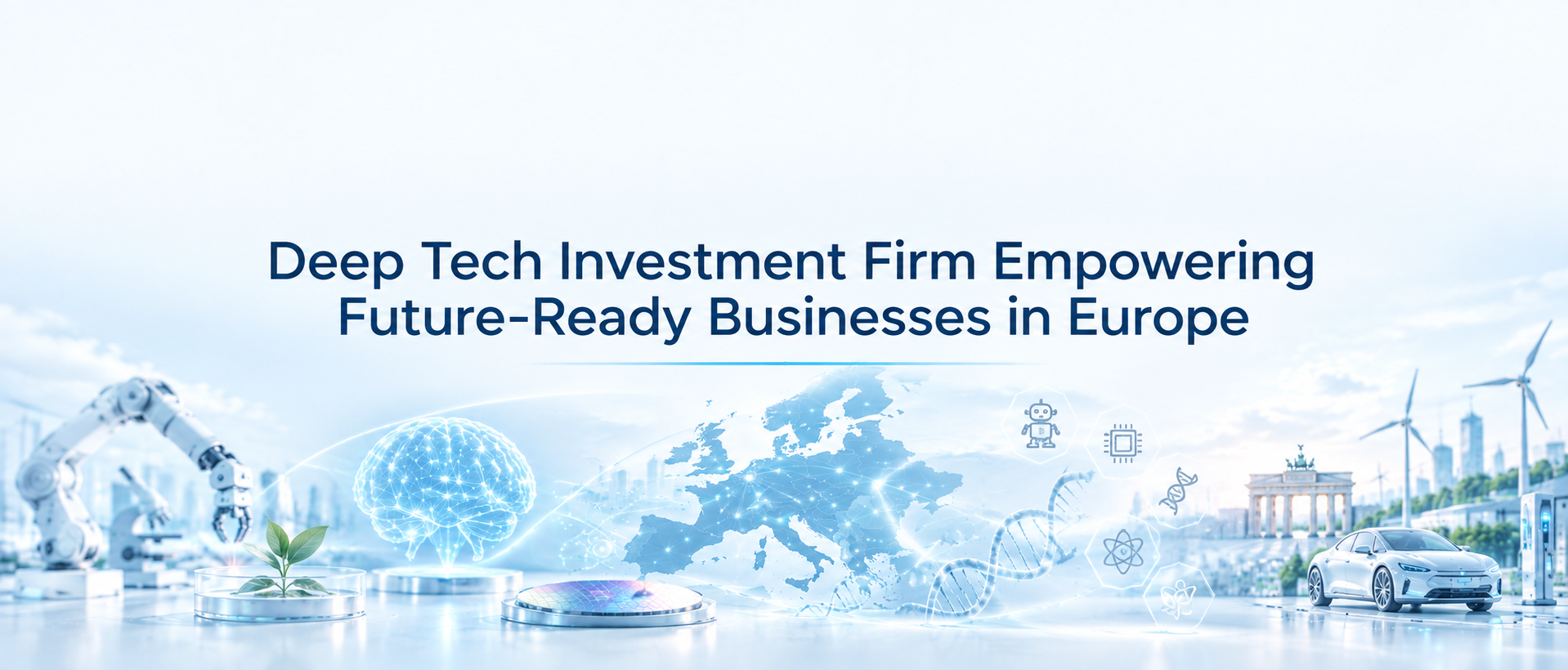
Deep Tech Investment Firm Empowering Future-Ready Businesses in Europe
Europe’s deep tech industry is at a crossroads. Artificial intelligence, robots, semiconductors, biotechnology, quantum technologies, advanced manufacturing, and climate innovation are moving out of laboratories and into commercial markets. But it takes more than just technological prowess to turn scientific insights into scalable enterprises. Founders need patient finance, industrial collaborations, intellectual property skills, regulatory understanding and access to foreign markets. This is where a Deep Tech Investment Firm may make a crucial difference by putting together technological innovation with the financial and commercial resources needed for long-term growth.
The possibility is becoming evident in scale. The European Innovation Council (EIC) has put to work over €6.5 billion for European inventors throughout its programs, mobilising over €5 billion together with private investors and over 1,000 co-investors in the process. The EIC believes it has leveraged €3.50 in extra investment for every €1 put into the EIC fund. These numbers imply Europe is building a stronger finance environment around high-risk, high-potential innovations.
Why Deep Tech Needs a Different Approach to Investing
Deep-tech companies differ from traditional software startups in that tech development is generally more time-consuming, and requires far more capital. A software company might potentially deploy, test and tweak a product quite quickly. A semiconductor, robotics, biotechnology, quantum or advanced-materials company may need years of research, testing, certification, production development and customer validation before it can attain meaningful commercial size.
This means that traditional indicators are not enough for investors. A professional Deep Tech Investment Firm needs to analyse the technology readiness, IP protection, scientific proof, technical capabilities, manufacturing economics and potential size of the addressable market. The capacity of a founding team to go from prototype to repeatable production can be as crucial as early revenues.
This is a challenge the European Patent Office identified in its 2025 analysis of technology investment, which found that European innovation investment is heavily reliant on large governmental programs and specialised private investors. The EPO also pointed out the necessity of investors with competence in intellectual property for the commercialisation of cutting-edge discoveries.
How to Find the Best Deep Tech Investors in Europe: What Founders Should Look For
What founders should really look for when they are searching for best deep tech investors in Europe? Capital is vital, but the quality and relevance of an investor’s network can decide how quickly a technology business is able to get through its next growth phase.
A strong investor will grasp the technical risks of the industry of the company and will be able to support milestones other than fundraising. This can involve assisting to build industrial collaborations, identify commercial customers, beef up management teams, encourage international expansion and get enterprises ready for next rounds of funding.
Another essential aspect is your investment horizon. Deep-tech startups require investors that are willing to stay the course throughout technology validation and commercialisation and who are not looking for quick exits. The proper investor will have the financial discipline and a knowledge that technological development does not follow the same timetable as traditional digital enterprises.
Luxembourg, France and Germany: A Strategic European Triangle
Luxembourg shares with France and Germany benefits for deep tech venture capital firm. Luxembourg has an internationally connected financial environment and might be a good location for cross-border investment structures. France has a robust research ecosystem, engineering skills and a rising startup environment, particularly in sectors related to artificial intelligence, aircraft, energy and industrial technologies.
Germany provides a third key piece to the table: industrial capability. Its engineering, manufacturing and Mittelstand ecosystems offer possible pathways for technologies to go from prototypes to industrial implementations. Tech firms and traditional manufacturers can team up to push forward robotics, automation, mobility, innovative materials, energy systems and industrial software.
The combination makes an interesting cross-border model. A French company creating cutting edge tech may profit from German industrial alliances, Luxembourg based investment structures can provide access to international cash. For a Deep Tech Investment Firm, recognising these linkages can add value beyond the original financing round.
Top Deep Tech Funds in Europe and the Commercialisation Gap
The emergence of leading deep tech funds in Europe is a sign of a wider realisation that scientific excellence does not necessarily transfer into economic success. One of the recurrent issues in Europe has been the so-called scale-up gap where promising companies can get early funding, but struggle to get the bigger rounds needed for production, international expansion and market penetration.
The latest impact data from the EIC suggest this disparity is closing. Today, over 80% of EIC agreements have cross-border investment flows, mirroring the increasingly international nature of Europe’s deep-tech funding ecosystem. The EIC also says that there are over 1,000 investors who co-invest alongside its programs.
The lesson for founders is apparent – fundraising strategy needs to be built around the whole development pathway of the company. Ideally, early investors should have a concept of what funding, collaborations and technological milestones would be required at later stages.
Beyond Capital: Preparing Companies for Sale
The best investing partnerships don’t stop with the transaction. Deep-tech innovators may need help with intellectual-property strategy, market positioning, regulatory planning, industrial validation and worldwide company development. Strategic introductions can also allow companies to connect with research groups, manufacturers, corporate clients and potential future investors.
This is especially true as a startup progresses from a technical demonstration to a commercial implementation. Investors should ask if the technology works reliably outside of controlled surroundings, if production can grow inexpensively, and if customers have a compelling motive to adopt it.
A pertinent example is Boundary Holding, a Luxembourg-based deep-tech venture capital firm, which claims to focus on AI, IoT, robots and Big Data technology. The stated investment method is for Pre-Series A, Series A and Pre-Series B startups and provides both financial and strategic help and worldwide networks.
Conclusion
The capacity to translate scientific information into enterprises that can compete worldwide will increasingly determine Europe’s competitiveness. There are already significant universities and research institutes, engineering talents and industrial clusters throughout the continent. The only remaining hurdle is to develop enough linked financing and commercialisation channels around them.
As such, a deep-tech venture capital firms role goes beyond capital provision. Seasoned investors may guide founders throughout technology development, intellectual property, industrial collaborations, cross-border expansion and later-stage finance. As Europe scrambles to connect Luxembourg, France and Germany with other technology hotspots, professional investors will play a greater role in translating promising research into solid, globally competitive enterprises.