
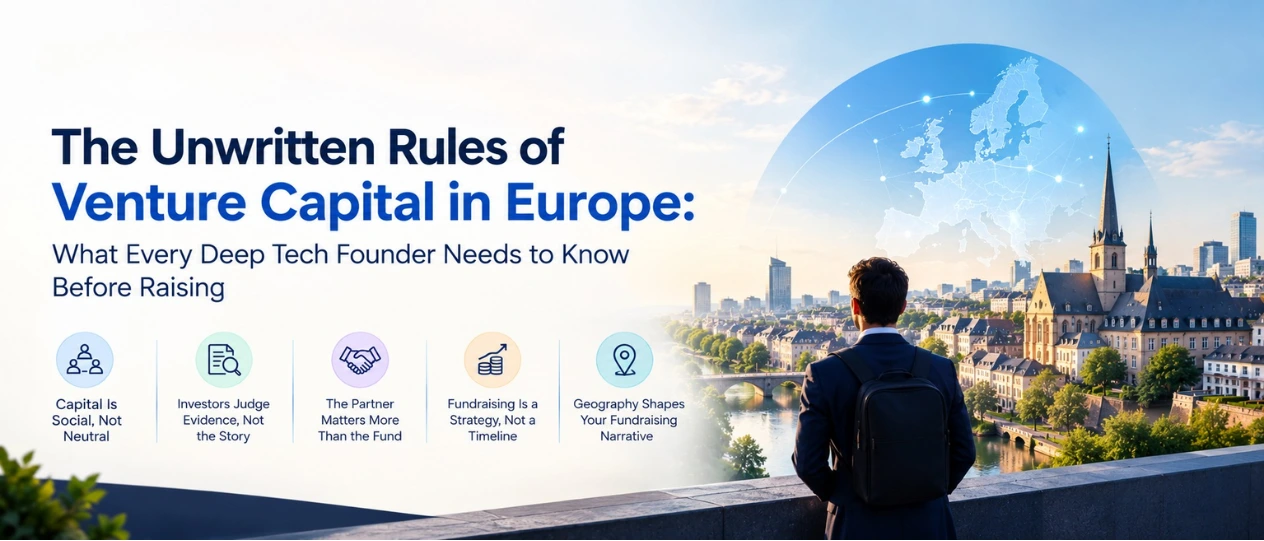
The Unwritten Rules of Venture Capital in Europe: What Every Deep Tech Founder Needs to Know Before Raising
Venture financing in Europe turns out to be nothing like what entrepreneurs imagine. While the playbooks existing in the founders’ community teach you such things as how to present a perfect pitch deck, which benchmarks to use for the evaluation, and how to make warm introductions, the inside of the room seems to operate under a different set of principles. These principles are hardly ever documented and seldom discussed publicly, yet they define the fate of most fundraising efforts.
When it comes to deep tech entrepreneurs, it is essential to learn these unwritten principles. The difference between a successful fundraising process and one dragging on for eighteen months is almost guaranteed to shape the future of your firm negatively in the former case and positively in the latter.
Rule One: Capital Is Social, Not Neutral
One of the most important things for a European deep tech entrepreneur to realise before raising funding is the fact that capital is social by nature – it goes where people know each other. The founder’s perception of risk, timings, barriers to entry, market segment and distribution channels gives the investors an impression of what can be funded even before any figure is assessed.
This explains the persistence of geographical advantages that play a role completely independent of the level of startup development. Funding is concentrated in a few places such as London, Berlin, Amsterdam and the like which makes it much harder for companies outside of that circle to raise funding since they have to exert about 30-40% more effort to achieve the same results. Therefore, the presence of a strong lead investor from the well-known city minimises the risk of fundraising failure.
For deep tech entrepreneurs who mostly create their businesses in university and research areas this imply that networking is the part of the fundraising process. The best time to meet the representatives of the related investment firms is a year before the actual fundraising process starts.
Rule Two: Investors Are Judging the Evidence, Not the Story
The degree of tolerance that Europe has for the blurry stories has never been less than it is now. Investors put their money in firms, which deal with difficult issues tasking various types of computing machinery, hardware, means of defence, systems for autonomous driving and advanced implementation of AI in any enterprise. What they do not accept anymore is the convincing story that is not supported by the facts.
The criteria of selection applied by the famous venture capitals have changed dramatically. Entrepreneurs are not evaluated on the basis of their potential only. Now, they are evaluated with the help of the pressure test.
Founders of deep tech start-ups face a certain challenge and a certain opportunity.
Rule Three: The Partner Matters More Than the Fund
When evaluating popular venture capital companies in Europe, the individual partner you will work with matters far more than the institutional brand above the door. The VC partner you choose is a ten-year decision. The individual partner not the firm’s name will be your day-to-day reality through missed milestones, pivots, difficult board conversations, and the moments when your company most needs someone who shows up.
The most rigorous founders treat investor diligence the way they would treat a key hire. They speak not just to the references provided who will always be positive but to founders from that partner’s struggling or failed portfolio companies. A VC who behaves well when a company is performing is not being tested. The only version of the relationship that truly reveals character is the one that happens when things are hard.
Due diligence in European venture now moves slower, not faster. Seed rounds that once closed in six weeks now take four months. This extended timeline is not obstruction. It is conviction-building and founders who treat it as such, entering the process with complete data rooms and documented technical proof points, close at better terms and with better alignment.
Rule Four: The Fundraising Sequence Is a Strategy, Not a Timeline
Deep tech entrepreneurs make one of the costliest mistakes in fundraising, by thinking of it as just another linear event in their journey instead of as a complex funding strategy. The best way to go about fundraising successfully is by implementing a combination of relief funds, angel investors, and VCs during distinct stages of fundraising.
The major competitive edge that deep tech entrepreneurs can use while raising funds is the support of European Union’s governmental support programs that provide grants and other types of non-dilutive funding. Programs like the European Innovation Council, Horizon Europe, and Scaleup Europe Fund that was legally formed in August 2026 with $5 billion in its fund are designed to maximize the operating time of taxpayers’ companies before they raise their first investment rounds of funding.
The founders who neglect to take advantage of this government funding support and choose to turn their attention to popular VCs instead are wasting money on equity dilution at the wrong moment in their business journey.
Rule Five: Geography Shapes Your Fundraising Narrative
European founders face a specific challenge that their US counterparts largely do not: investors still fear fragmented markets and slower scaling in Europe. This fear is not entirely rational but it is real, and founders who do not address it directly in their fundraising narrative will encounter it as an objection in every serious conversation.
The most effective response is not to minimise European fragmentation. It is to explain precisely how your go-to-market is designed around it which regulatory jurisdictions you are prioritising first and why, which industrial or government customers give you the fastest path to commercial validation, and how your unit economics hold across markets with different procurement cycles and buyer behaviours.
Popular venture capital companies in Europe that specialise in deep tech understand this landscape and will probe it rigorously. Founders who have thought through these questions before the meeting will close faster and on better terms than those who encounter the questions for the first time across the table.
Boundary Holding: A Venture Partner Built for Deep Tech Founders Who Play the Long Game
Boundary Holding is among the well-established investment firms in Europe that identify opportunities across AI, robotics, autonomous drones, and advanced sensors, and this is precisely how they have developed their business model.
With its headquarters in Luxembourg and investment activities across the entire European deep tech ecosystem, the firm can identify high-potential companies before they become sought after, thus eliminating the need for the founding teams to rely on networks that are not easily available to them considering their geographical location. Their strong synergy with the European Innovation Council and the Strategic Technologies for Europe Platform grants their portfolio companies access to the institutions, government innovation programs, and co-investment channels that would help them make sure they do not face problems resulting from the peculiarities of European venture.
For innovators in Deep tech, Boundary Holding is something more than just a source of financing because its main principle underlying its approach is that the venture partner does not have to be the one who can invest the most amount of money, but rather the one who is knowledgeable and knowledgeable enough to be there when it matters and open doors for the company.