
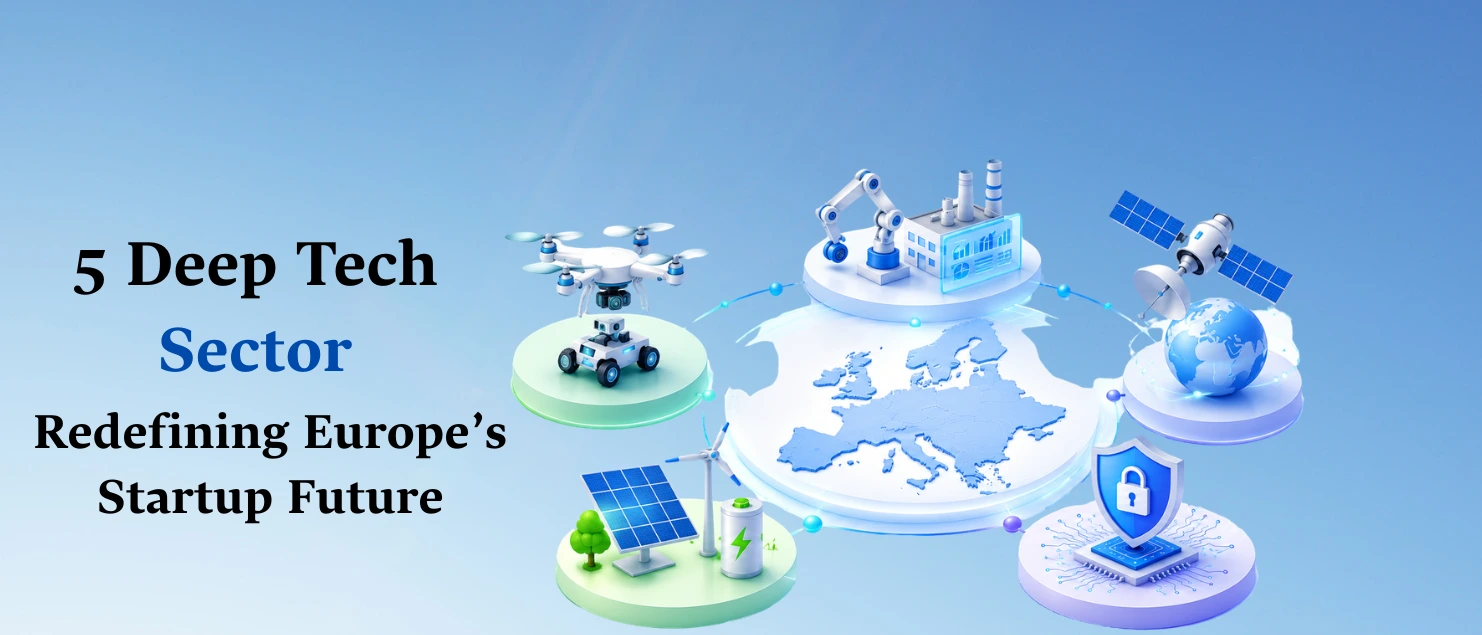
5 Deep Tech Sectors Redefining Europe’s Startup Future
Over the past decades, the ecosystem of European startup has undergone a major transformation, once working on models like software-as-a-service (SaaS) now progressively transformed into hardware focused, research-intensive breakthrough. Driven by industrial modernization, strategic autonomy, and climate resilience, deep tech has developed as a Beacon for European Venture capital market.
The European Innovation Council is one of the major forces behind this transformation. With a capital of more than €10 billion under the Horizon Europe framework (2021–2027), the EIC has arisen as the Europe’s premier deep-tech investor. Through tools like the EIC Accelerator, it fills up a critical financing gap by deploying billions in blended finance (the grants combined with direct equity) to innovations like de-risk high-stakes hardware. Its recent tech report clearly highlight the exact strategic sectors considered critical for a country’s competitiveness and resilience.
The EIC actively supports secure and distributed AI systems aimed to maneuver at the edge. These inventions cover the lifespan of traditional networks and dissociate heavy industry from energy incompetence. Specialized private funds, like Luxembourg’s bridge fund Boundary Holding, plays its part when it comes to handling commercial scaling.
Looking at the current funding landscape, five distinct deep-tech sectors have moved from the borders of research labs to the center of European industrial strategy.
1. Heavy Industrial AI & Infrastructure Analytics
Artificial intelligence in Europe is rapidly moving away from consumer chatbots and generative art. Instead, the real money is flowing into the physical operating environments of factories, rail networks, and utility grids. By hooking machine learning up to heavy Internet of Things (IoT) sensor arrays, companies are turning raw operational noise into predictable maintenance schedules.
The EIC actively favors this localized approach, pushing for edge-computing systems that process data right on the factory floor rather than shipping it to foreign cloud servers. Private capital is tracking this public priority closely. For instance, Munich-based KONUX has scaled intelligent sensor systems that monitor national railway lines to predict structural failures before they happen. Similarly, firms like Switzerland’s Kido Dynamics are utilizing deep data algorithms to help cities map and optimize public transit patterns.
2. Non-Line-of-Sight Autonomous Systems & Tactical Robotics
Automation is breaking out of the clean, predictable cages of automotive assembly lines. The current frontier involves building autonomous machines capable of navigating chaotic, dangerous, or completely GPS-denied environments without human intervention.
Because maintaining a domestic manufacturing and defense edge is a core security goal for the EIC, public funds are heavily subsidizing specialized navigation hardware. Private investors are mirroring this thesis by backing highly technical engineering teams across the continent. This includes French startups, like Internest, which developed localized ultrasonic landing arrays to guide drones onto moving ships, and Aeraccess, which builds ruggedized tactical aircraft for hostile inspections. In the heavier asset space, SwissDrones is deploying unmanned helicopters to take over high-risk aerial inspections originally done by manned crews.
3. Sovereign Space Infrastructure & Nanosatellites
Europe’s “New Space” sector is defined by a push to democratize orbit. The historical monopoly of state-run space agencies is giving way to nimble commercial satellite networks. These systems provide the high-frequency Earth observation and remote data links required by modern logistics, agricultural monitoring, and defense frameworks.
Recognizing the strategic vulnerabilities of relying on third-party satellite networks, the EIC has carved out dedicated funding challenges for orbital manufacturing and secure satellite communications. This baseline of public stability has opened the doors for private funds to invest in capital-heavy space tech. A prime example is Astrocast, a Swiss operator running a Low-Earth orbit nanosatellite network that provides bi-directional data tracking for maritime and industrial assets operating outside regular cellular coverage.
4. Hardware-Centric Climate Tech & Grid Resilience
Driven by aggressive legislative mandates for carbon neutrality, European green technology has evolved. Venture capital has largely realized that carbon accounting software does not move the needle; instead, the focus has shifted to the grueling physics of energy storage, grid modernization, and asset optimization.
The EIC’s Clean and Resource-Efficient Technologies challenge actively funds the heavy lifting: battery chemistry breakthroughs, circular economy hardware, and high-voltage grid digitalization. Commercial capital is running parallel to these initiatives. While massive gigafactory plays like Sweden’s Northvolt capture the headlines, smaller, highly targeted infrastructure tech is quietly scaling. This includes Skilancer Solar’s waterless robotic systems for cleaning solar panels in arid regions, and Withthegrid, a Dutch utility monitoring platform that recently handed its early venture backers a successful commercial exit.
5. Embedded Hardware Cryptography & Quantum Security
As industrial machines, energy grids, and satellite constellations become interconnected, cybersecurity is no longer just an IT headache, it is a matter of national defense. The current crop of deep tech startups has abandoned reactive software patches. Instead, they are building cryptographic security directly into the physical silicone chips and data transport protocols.
The EIC is aggressively financing quantum-safe communication networks to prevent long-term vulnerabilities to foreign decryption threats. This security ecosystem has allowed data privacy firms like Switzerland’s CYSEC to find a solid foothold. By creating isolated, confidential computing environments, they protect sensitive data workflows across terrestrial banking systems and edge-computing payloads on commercial satellites alike.
The Interconnected Future
The real value of this deep tech surge is not found in any single sector, but in how these five verticals interact. They form an interdependent web. The hardware cryptography built by security firms is loaded onto Low-Earth orbit satellites, which then secure the data streams used by tactical drones and industrial AI networks on the ground. By pairing the risk-tolerant capital of the EIC with the commercial speed of private venture funds, Europe is building a defensive, self-sustaining loop designed to keep its best intellectual property and engineering talent within its borders.