
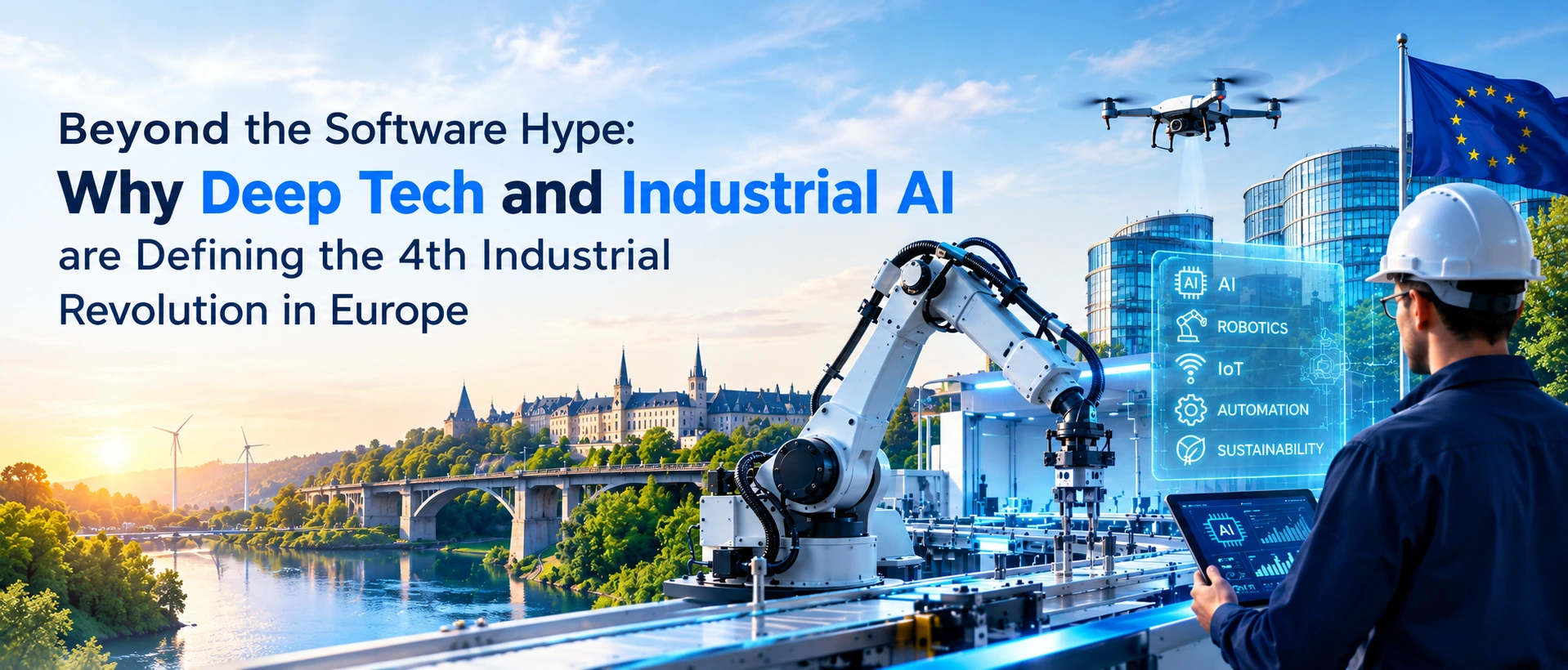
Beyond the Software Hype: Why Deep Tech and Industrial AI are Defining the 4th Industrial Revolution in Europe
For over a decade, the tech conversations have been all about slick mobile apps, lightweight software, and consumer tech. While the “SaaS revolution” completely transformed how we consume media, manage workflows, and communicate, it represents only the surface layer of digital transformation. Today, a much more profound shift is underway. We’re moving past the era where cloud-based code defines the tech world. The 4th Industrial revolution (Industry 4.0) is no longer be defined by lines of code running in the cloud, but by the fusion of physical engineering and advanced intelligence.
As Europe looks to secure its economic resilience and technological sovereignty, the focus is shifting from software trends towards European Deep Tech. at the center of it all are heavy, science-backed breakthroughs, think-smart manufacturing setups, and self-operating heavy machinery. These apps are the kind of hard innovations that are set to completely overhaul heavy industry, infrastructure, and supply chains from the ground up.
Boundary Holding: Fueling the Next Wave of Industrial Evolution
Rather than sitting back and waiting for pitch decks to arrive, Boundary Holding takes a proactive, boots-on-the-ground approach to shaping Europe’s industrial future. As a specialized Luxembourg venture capital firm and deep tech fund, it operates as a vital bridge venture fund, actively scouting the European and global ecosystems for IP Pioneers in industrial AI startups, autonomous drone tech, and advanced automation. In a landscape where traditional software funds often stick to the safe, light-asset path, this European venture fund leans heavily into deep tech investing, aligning directly with the European Union’s push for technological sovereignty. By utilizing deep regional expertise to help early-stage deep tech businesses, Boundary Holding does more than just fund innovation, it opens the gateway for global technologies to scale successfully across the single market, solidifying its place among top-tier Industry 4.0 VCs.
Key Pillars of the New Industrial Era
- Industrial AI & Smart Manufacturing: Traditional machine learning is shifting into heavy-duty industrial AI. These systems can spot equipment issues before they cause downtime, fine-tune energy distribution, and react to supply chain disruptions on the fly.
- Autonomous Systems & Robotics: From fulfillment centers to drone-based border security, autonomous drone tech machines are replacing human workers in high-risk environments.
- Hardware-Software Integration: Today’s most successful startups are the ones tackling the physical world. By hooking up IoT sensors, using edge computing, and bringing in new materials, they’re taking old industrial machinery and finally bringing it into the connected age.
The Role of Capital: Why Deep Tech Investing Requires a Different Breed of VC
Building physical products or rolling out factory-floor AI is a totally different game than writing software. The classic Silicon Valley rule of “move fast and break things” will just crash and burn here. This space requires careful technical vetting, deep pockets, and investors who are willing to play the long game.
That’s where specialized European deep tech funds step in. While standard VC firms get scared off by the long wait times and regulatory tape, Industry 4.0 specialists think differently. They know that lasting value isn’t about quick wins; it’s built on bulletproof IP and physical assets that are nearly impossible to replicate.
By acting as a Bridge venture fund, forward-thinking investors help university labs and research spin-offs to actually turn their brilliant ideas into real, scaling businesses.
Europe’s Advantage in the 4th Industrial Revolution
Europe is uniquely positioned to lead this new wave. Backed by world-class engineering universities, stringent data standards, and a rich heritage in manufacturing, automotive, and aerospace industries, the continent has an abundance of raw technical talent.
Tech hubs centered around spots like Luxembourg are pulling in early-stage deep tech talent left and right. By funneling funds into industrial AI, Europe is making a statement: instead of just consuming technology built overseas, it’s going to build the actual foundation of the next global economy.
Conclusion
The endless software hype is finally cooling down, and we’re entering a phase where actual engineering depth and real-world use cases matter more than buzzwords. The next 4th industrial revolution isn’t going to play out on phone screens, it’s happening right inside factories, shipping hubs, and labs.
As specialized funds continue to champion deep tech investing, Europe has a historic window of opportunity. By backing the pioneers of physical-digital convergence, the continent is laying down the tracks for a more productive, sustainable, and technologically sovereign industrial future.