
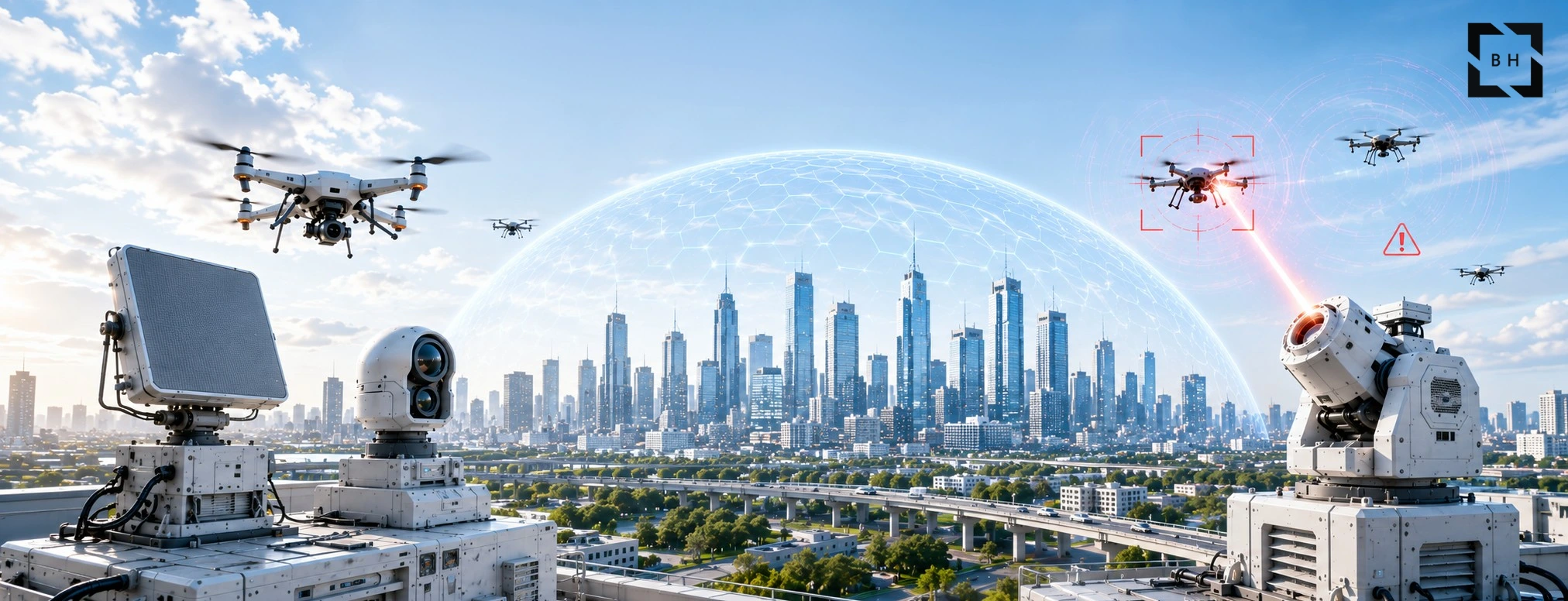
Securing the Modern Airspace: The Critical Role of AI in Detection, Tracking, and Neutralizing Autonomous Threats
Drones have transformed from being a gadget of hobbies to something much more expedient. Now, if we look forward, Drones have developed as a common prospect in both Military and Civilian environment. While they have the ability to offer many beneficial applications, from photography in the sky to package delivery, their speedy growth has also created challenges of security. If we talk about counter-drone systems, it has developed as a critical defense tool, and new age Artificial Intelligence now plays an essential part in making these systems more operational. The newer firms seeking investments and capital have been well supported by firm such as Boundary Holding, a Bridge fund firm in Europe.
Integration of AI for Unmanned aerial system/ Drone
Drones, also known as unmanned aerial systems, are highly navigable and proficient of carrying various goods. Small unmanned aircrafts usually fly at low altitude, carry cameras, blend into background clutter or operate in large numbers as swarms, often struggle in operating with the traditional detection methods such as radio frequency monitoring, radar and visual observation. This gap simply creates too many false alarms, and leads to come up with the integration of AI to advance detection, tracking, and response capabilities.
How AI Enhances Counter-Drone Operations
New age counter-drone systems usually operate on the basis of three key functions: Detection, tracking and neutralization. Artificial Intelligence considerably fortifies each of these areas with the help of advanced data processing and pattern recognition.
Detection- the advanced AI-powered systems collect and combine data from various sensors, including radar, acoustic sensors, optical and thermal cameras, and radio frequency detectors. The automated learning algorithms examine this data in real time, differentiating drones from birds, aircrafts, or other objects with high level accuracy. The machine vision systems, skilled on extensive image datasets, identification of different drone shapes, flight patterns, behaviors even in intricate environment.
Tracking- Once a potential threat is recognized, AI helps in maintaining continuous tracking. Machine learning analytical algorithms estimate the movement of drones, accounting for rapid changes in direction or speed. Sensor fusion technology combines inputs from diverse sources to generate a reliable, integrated image of the threat. This diminishes false alarms and allows operators to focus on genuine risks.
Neutralization- AI benefits in selecting and executing the most suitable responses. Common approaches embrace kinetic projectiles, signal jamming, interception with nets or other drones, or directed energy systems such as lasers. Some platforms utilize AI to endorse the optimal response or, in certain cases, assist autonomous engagement while maintaining human error for the final decision.
Notable Systems and Approaches
Several Venture capital firms in Europe have established refined AI-driven counter-drone solutions:
CerbAir: A prominent European startup specializing in Counter Unmanned Aerial systems (C-UAS). Their advanced technology system concentrates on the real-time recognition, identification, tracking, and neutralization of indiscreet drones. They operate on radio frequency (RF) investigation and visual tracking algorithms to examine the airspace.
Dronefence: Germany-based, Dronefence advanced in multi-modal drone detection systems. Their dedicated setup depends on modified multi-sensor arrays and camera tracking systems to confine unauthorized drones entering protected airspaces, utilizing automated learning algorithms to differentiate concerning authorized and untrusted aircrafts.
Elistair: Computerized tethered drone systems are utilized for continuous, persistent surveillance.
Skycharge: Autonomous charging pads and infrastructure for commercial and surveillance drone fleets.
Key Advantages of AI Integration
The utilization of artificial intelligence brings numerous concrete benefits to counter-drone operations:
Speed: AI can instantly process large volumes of sensor data, which enables speedy response times that are critical to deal with fast-moving threats.
Accuracy: Automated learning condenses false positives, and helps to prevent from unnecessary alerts and conserving resources.
Scalability: Automated machine learning systems can manage several concurrent threats, including drone swarms, more efficiently than traditional methods.
Adaptability: In the long run, these machine learning systems learn from new data and growing drone tactics, refining performance without requiring persistent manual updates.
The Road Ahead
The Future of Anti-drone technology will probably involve even better autonomy, the usage of edge computing for faster on-device processing, and tighter integration with larger airspace administration networks. As the technology of drone constantly advance, AI-driven counter drone systems will remain critical for managing security in both civilian and defense settings. The enduring advancement of these tools imitates a larger effort to balance modification in unmanned aircrafts with essential safety methods.