
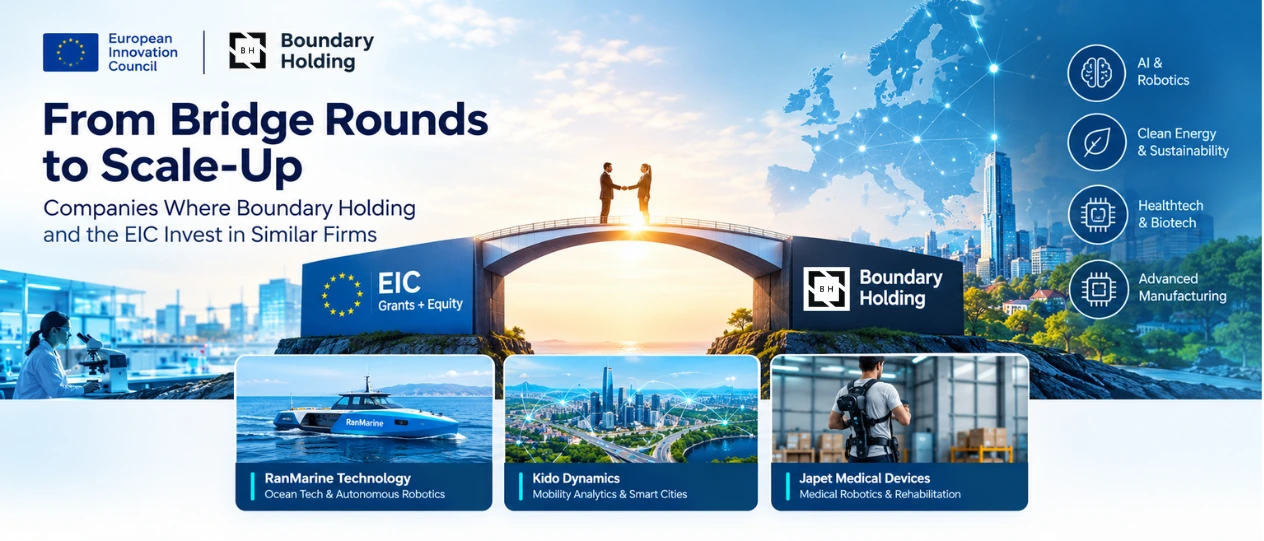
From Bridge Rounds to Scale-Up: Companies Where Boundary Holding and the EIC Invest in Similar Firms
The European technology landscape is experiencing a structural shift, particularly across complex, physical-world technologies. In the world of a Deep tech fund or a European venture fund, bridging the gap between scientific breakthrough and commercial scale presents a unique set of challenges.
At the center of this ecosystem stands the European Innovation Council (EIC). Operating as Europe’s flagship public innovation instrument, the EIC de-risks high-stakes science through grants and blended equity via the EIC Accelerator. However, non-dilutive public funding alone rarely carries a company to market dominance.
This is where private specialized capital steps in. As a prominent player in Deep tech investing, firms like Boundary Holding act as private-sector bridge partners. By analyzing the overlap where both Boundary Holding and the EIC invest in similar or co-funded ventures, we can see how public grants and private venture capital combine to power European deep tech.
What is a Deep Tech Bridge Round and Why Does It Matter?
Building a European deep tech is a completely different scenario than launching a traditional software app. Whether you’re looking at autonomous robotics, quantum computing, biomechanics, or energy infrastructure, these companies demand massive capital investments and years of development before seeing real traction.
Securing an EIC accelerator grant is a huge vote of confidence for an early-stage team, proving their core tech actually works at TRL 5-6. But getting from a working prototype to a market-ready product (TRL 7-9) takes real operational muscle, active sales pipelines, and private backing. That’s where a specialized deep tech fund comes in, stepping up with bridge capital to keep the lights on until a proper Series A or B comes together.
Two Independent Approaches, One Shared Landscape
Boundary Holding steps in right around the bridge phase, offering targeted backing to startups that already have their tech validated and some early commercial momentum under their belt. That capital gives these founders enough runway to expand across Europe and reach their next set of milestones, particularly in hard-tech and AI built for real industrial or environmental challenges.
Meanwhile, the EIC Fund offers larger-scale, patient equity, often paired with grants via its Accelerator or STEP Scale Up initiatives. It targets startups and SMEs working on disruptive tech that can unlock entirely new markets. At its core, the fund’s public mission is to fix Europe’s deep-tech funding shortage and draw in private capital alongside it.
Since, both Boundary Holding and the EIC put startups through intense technical and business evaluations, their investments picks often overlap. What you end up with is a strong group of European deep-tech companies backed by both a specialized private bridge investor and the EU’s top public deep-tech program.
Key Companies Backed by Boundary Holding and EIC Frameworks
- RanMarine Technology- Operating in the autonomous maritime robotics and ocean tech sector, Netherlands-based RanMarine Technology highlights how public grants and private equity interact.The company secured an EIC Accelerator grant under Horizon Europe to develop and de-risk its zero-emission autonomous surface vessels, known as the WasteShark, which collect floating plastics, biomass waste, and track water quality metrics. Recognizing the commercial potential of this validated hardware, Boundary Holding stepped in as a principal venture capital investor, holding an equity stake of approximately 20%. This private bridge investment provided the growth capital required to expand manufacturing capacity, establish global distribution channels, and secure enterprise contracts with international ports and harbors.
- Kido Dynamics- Switzerland’s Kido Dynamics operates at the intersection of mobility analytics, smart cities, and physics-based artificial intelligence. The startup was awarded an EIC Accelerator grant to advance its proprietary platform, which uses physics principles and big data to analyze human mobility and traffic flows without compromising user privacy. Following this public validation, Boundary Holding backed Kido Dynamics with private venture capital. This private bridge capital allowed Kido Dynamics to transition from algorithmic proofs-of-concept into full enterprise deployments with European telecommunications operators, urban planners, and transportation authorities.
- Japet Medical Devices– French medical robotics innovator Japet Medical Devices combines biomechanics and industrial robotics to build motorized ergonomic exoskeletons designed to reduce back injuries and aid physical rehabilitation. Japet earned the prestigious EIC Accelerator Seal of Excellence and received backing across European innovation frameworks like EIT Health to execute clinical validation trials. Boundary Holding subsequently joined as a key private investor, injecting capital aimed at driving commercial B2B sales networks across industrial logistics centers, manufacturing facilities, and corporate health sectors.
Strategic Alignment in European Deep Tech Investing
In Europe, deep tech investing basically comes down to how well government institutions and private venture funds work together. When big institutional investors look at European VC funds, they want managers who know how to spot standout startups right at the sweet spot, when public grants have already proven the tech actually works.
It’s all about low-risk co-investing. A grant from something like the European Innovation Council (EIC) acts as a green light, showing that the core technology is sound. That gives private firms, like Boundary Holding, the confidence to step in and put real equity capital behind the company.
There’s a clear division of labor here: public money funds the messy R&D phase, while private bridge rounds fund the actual business expansion. That means setting up enterprises B2B sales cycles, building out manufacturing supply chains, and landing international customers. At the end of the day, keeping these two sides aligned protects Europe’s technological independence, keeping ground-breaking IP and physical manufacturing rooted firmly on European soil.
Conclusion: Building the Scale-Up Pipeline
Public innovation grants and private bridge equity represent complementary forces in European deep tech. The EIC identifies and validates radical scientific innovation. Meanwhile, specialized funds like Boundary Holding build the commercial bridge required to turn research projects into global market leaders.
For founders navigating post-grant growth, combining public grant validation with private bridge equity provides a clear path from laboratory success to global commercial scale.