
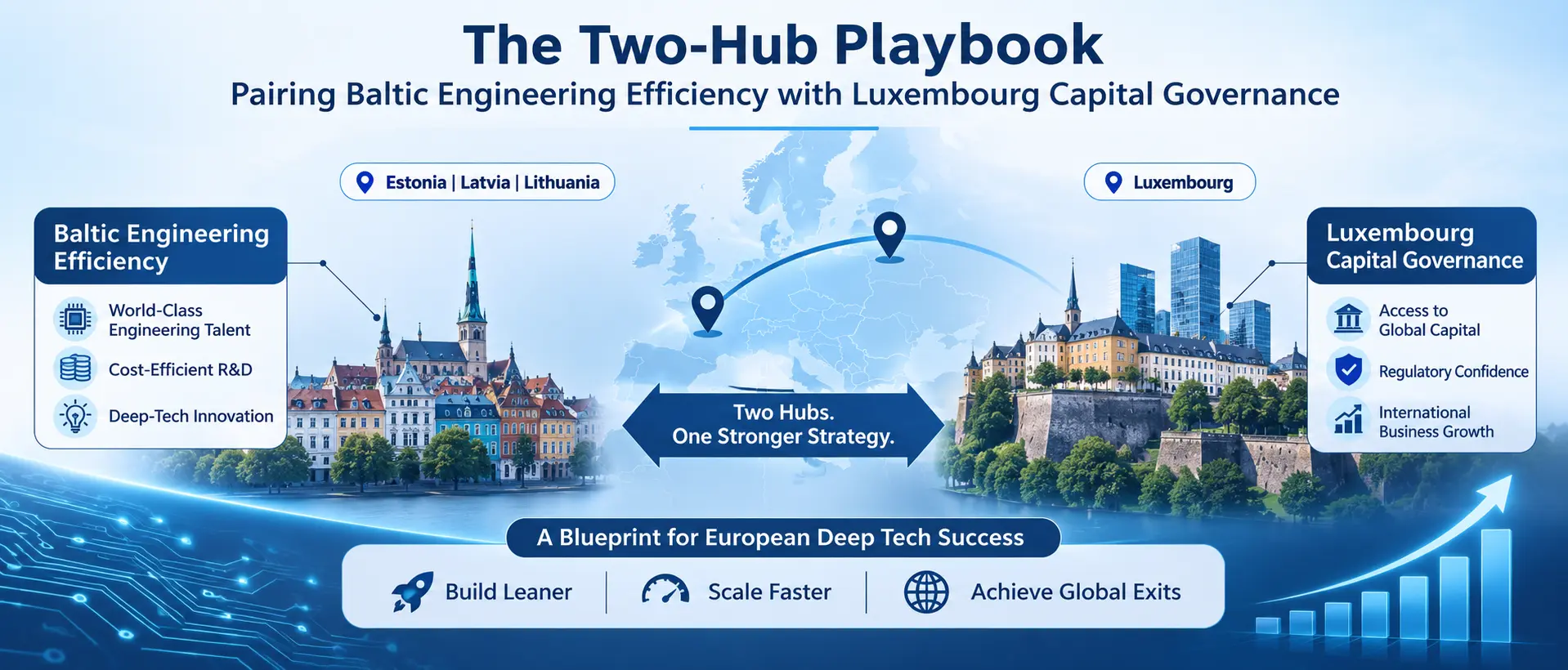
The Two-Hub Playbook: Pairing Baltic Engineering Efficiency with Luxembourg Capital Governance
For years, European deep-tech founders faced a difficult trade-off. If they built their company in Central or Eastern Europe, they enjoyed world-class engineering talent and lean operating costs, yet struggled to access deep institutional capital and global enterprise networks. Conversely, setting up entirely in western Europe meant immediate proximity to major investors and regulators, but at a burn rate that could cripple a capital-intensive R&D company before its product ever reached the market.
Today, a more sophisticated operational blueprint is reshaping how European technology companies scale: The Two-Hub Playbook. Rather than forcing an entire business into a single geography, founders are separating their operational footprint across two specialized European centers, keeping research and development in capital-efficient Baltic and Eastern European hubs, while anchoring institutional governance, cross-border compliance, and global sales in Luxembourg and Western Europe.
Pillar One: Baltic Engineering Efficiency
The first pillar of this playbook is Baltic engineering efficiency. Countries like Estonia, Latvia and Lithuania have evolved far beyond general software outsourcing into specialized powerhouses for artificial intelligence, robotics, defense technology, and autonomous systems. Estonia alone captures a commanding share of deep tech momentum in the region, backed by digital-first government infrastructure and a dense concentration of technical talent. For early- and growth-stage startups, maintaining core R&D in these hubs extends capital runway significantly, allowing teams to iterate on complex hardware and algorithms without the prohibitive overhead of London, Paris, or Frankfurt.
Pillar Two: Luxembourg Capital Governance
However, technical excellence alone rarely guarantees global scale. Many promising Eastern European startups encounter a “scale-up gape” when transitioning from product validation to international commercialization. Institutional investors sovereign funds, and multinational enterprise buyers demand rigorous corporate governance, clear intellectual property protection, and seamless regulatory compliance across jurisdictions. This is where the second pillar Luxembourg capital governance becomes indispensable.
As one of Europe’s premier financial centers, Luxembourg offers an unmatched environment for structuring holding entities, managing cross-border capital, and navigating. European regulatory frameworks. Anchoring corporate governance and strategic commercial operations in Luxembourg or Western Europe gives a Baltic-born startup immediate credibility with global institutional investors and enterprise customers. It creates a clean, transparent separation between day-to-day technical execution in the East and financial stewardship, licensing, and international business development in the west.
Validation in Practice: Boundary Holding and the Defendec Exit
This thesis sits at the core of Boundary Holding’s investment philosophy. Based in Luxembourg with a strong European footprint, Boundary Holding has consistently focused on identifying IP-rich artificial intelligence and deep-tech companies capable of solving complex global challenges. The firm’s successful exit from Defendec, an Estonian pioneer in AI-powered autonomous surveillance systems acquired by Canada’s Vosker Corp., serves as a compelling validation of how this cross-border model works in practice. Defendec demonstrated that a startup rooted in Estonia’s highly efficient engineering ecosystem could develop mission-critical technology used to secure NATO and EU borders, and ultimately attract a major international acquirer.
Bridging Europe’s East-West Innovation Divide
For Boundary Holding, bridging this divide is central to how we support founders. As Rajat Khare, founder of Boundary Holding, noted following the Defendec transaction, what sets the region apart is not merely its engineering prowess, but the ability of founders to build globally relevant technologies while maintaining disciplined, capital-efficient operating structures. By providing strategic capital and cross-border guidance from Luxembourg, Boundary Holding helps high-potential technical teams overcome fragmented national barriers and position themselves for global expansion.
A Repeatable Blueprint for European Deep Tech
As Europe sharpens its focus on technological sovereignty, AI and industrial resilience, the Two-Hub Playbook offers a repeatable blueprint for the next generation of founders. Startups no longer need to abandon their engineering roots or relocate to Silicon Valley to compete on the world stage. By pairing the speed of Luxembourg governance, European deep-tech companies can build leaner, scale faster, and achieve truly global exits.